If your company is celebrating 25, 50, 75 or 100 years, perhaps the smartest part of the anniversary budget is the part you can still hold in your hands twenty years later.
Company anniversaries have an interesting way of sneaking up on people.
For years, everyone knows that the big number is somewhere in the future. Then suddenly somebody looks at the calendar and realizes: next year we turn 50.
And that is usually when the planning begins.
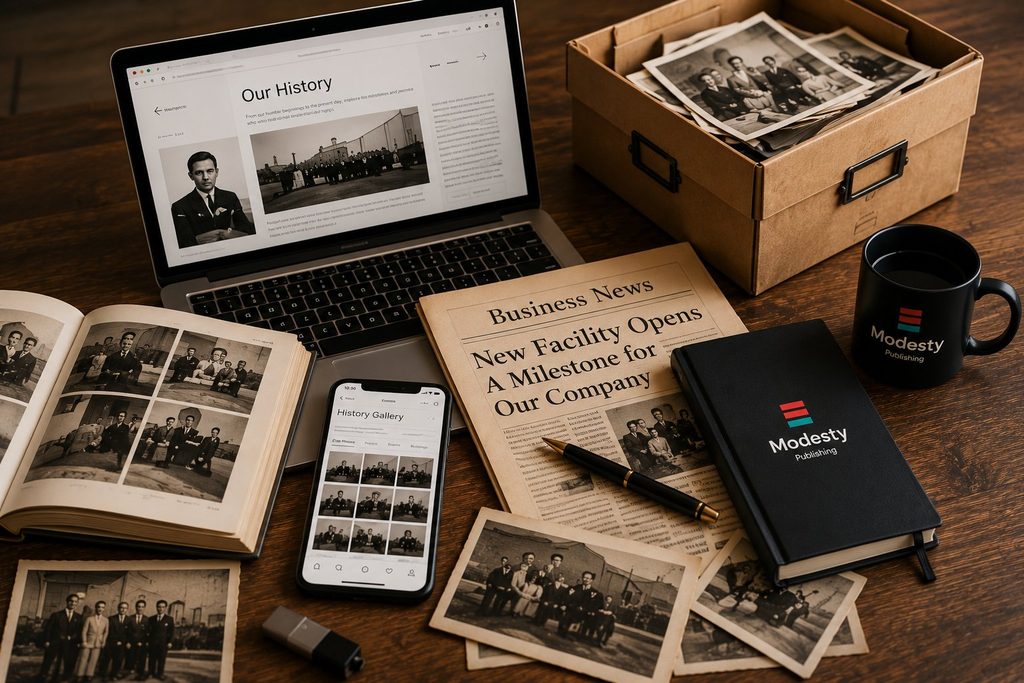
There will be a celebration, of course. Perhaps a special event for employees, clients and partners. Someone will suggest a film. The marketing team will create anniversary graphics. Old photographs will begin appearing in presentations and on social media. Former employees will be contacted. Someone will inevitably discover a box in a storage room that has apparently not been opened since 1987.
All of this is part of the fun.
But before the anniversary budget is spent, there is one question worth asking:
What are we creating that will still exist when the anniversary is over?
It is a surprisingly useful question because most of what companies purchase for an anniversary is designed for the moment. There is nothing wrong with that. A great celebration should feel special.
But a milestone of fifty or seventy-five years deserves something more than a memorable evening.
It deserves a memory.
You already paid for the history. Don’t lose it now.
Think about what it actually took to reach an important anniversary.
If a company is celebrating fifty years, it has already paid for fifty years of its story.
It paid for the first office. The first employees. The products that succeeded and probably a few that did not. It paid for expansions, difficult years, new equipment, new buildings, new markets and thousands of working days that eventually became the history of the business.
Along the way, it also accumulated something extraordinarily valuable: photographs, advertisements, newspaper articles, brochures, letters, awards, annual reports, videos, stories and memories.
Much of that material probably already exists.
The problem is that it rarely exists in one place.
Some of it is on the company website. Some is buried in digital folders. Older photographs may be in boxes. Former employees have others at home. A local newspaper may have documented an opening ceremony that nobody inside the company can find anymore. The founder’s family may have photographs from the earliest years that the marketing department has never seen.
An anniversary is one of the few occasions when everyone suddenly has a reason to look for these things.
That opportunity should not be wasted.
Instead of gathering all that history for a presentation, using it once and allowing it to disappear back into folders and boxes, use the anniversary as a deadline for creating a permanent record of the company.
That is where a Company Legacy Story Photo Book becomes much more interesting than another commemorative gift.
Start the book before you start the party
One of the smartest decisions an anniversary committee can make is to begin the book early.
Not because books necessarily take years to produce, but because history has a habit of revealing itself slowly.
You find one photograph and somebody recognizes a person in the background. That person remembers another event. Someone searches an old folder and finds a newspaper clipping. The clipping mentions a project nobody has discussed in twenty years. A retired employee is contacted and suddenly tells a wonderful story that has never been written down.
This is when an anniversary project becomes enjoyable.
The company starts rediscovering itself.
And importantly, you do not need to begin with a perfectly organized corporate archive. In many cases, the company’s existing website, public history, galleries, press releases, annual reports, social media and online archives already contain enough material to establish the structure of the story.
Once a first book concept exists, people find it much easier to contribute.
Show someone a blank page and ask, “Tell us about the history of the company,” and you may get silence.
Show that same person a photograph from 1994 and ask, “Who is standing next to you here?” and you may get a twenty-minute story.
That is the magic of a photo-driven history.
The photographs do not merely decorate the story. They unlock it.
Make the anniversary book about people, not corporate statistics
A company can publish its revenue, number of locations and major milestones almost anywhere. Those facts belong in its history, but they are rarely the reason somebody keeps an anniversary book on a shelf for thirty years.
People keep books because they find themselves, their colleagues, their parents, their friends or a piece of their own life inside them.
That is worth remembering when deciding what belongs in the book.
The first building matters because people walked into it every morning. The first delivery truck matters because somebody drove it. The first major contract matters because a team worked desperately to deliver it. The photograph from the company picnic in 1982 may ultimately mean more to a retired employee than a photograph of the newest corporate headquarters.
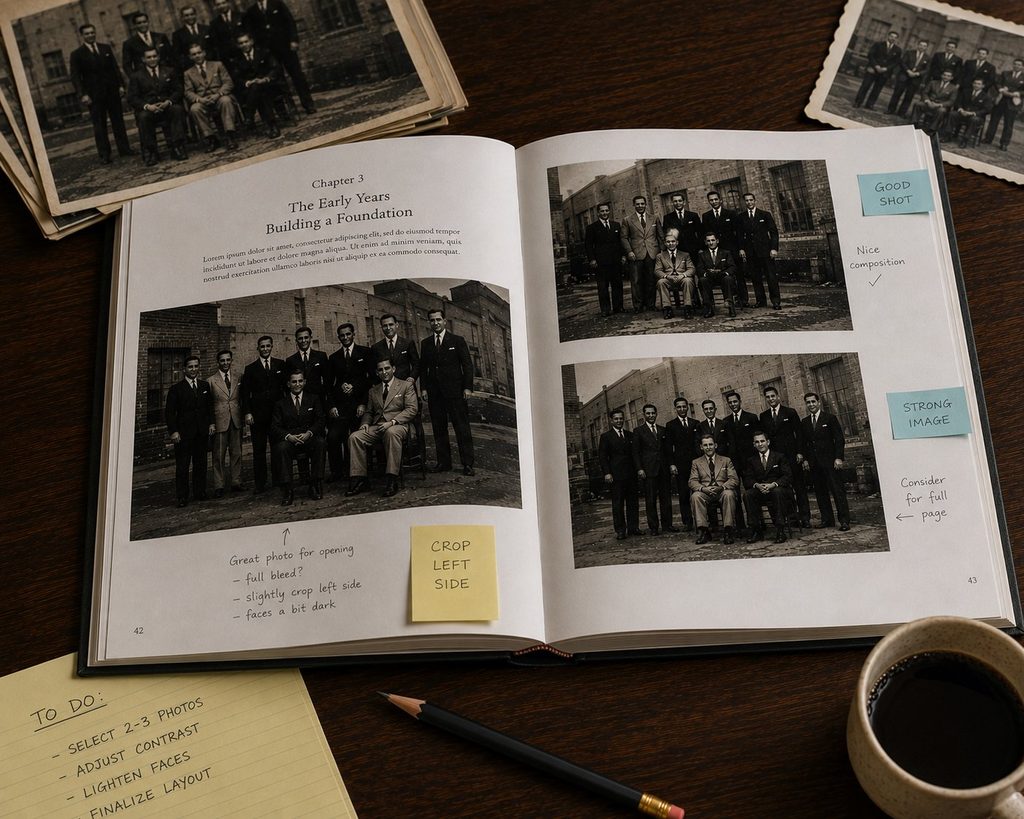
A good Legacy Story Photo Book should therefore feel less like an annual report and more like the biography of an organization.
Every good biography has achievements, but it also has beginnings, characters, difficult chapters, turning points, relationships, surprises and ambitions.
Companies have all of those too.
Give today’s employees a chance to meet yesterday’s company
There is another reason to make the book part of the anniversary rather than simply producing it afterward.
It can become part of the celebration itself.
Imagine employees arriving at a 50th anniversary event and seeing the company’s story laid out in front of them for the first time.
A 27-year-old employee discovers what the office looked like in 1976. Someone who joined ten years ago sees the founder standing beside the first company vehicle. A longtime employee finds a photograph of herself from her first year at work. A client discovers that his father was already doing business with the company decades earlier.
Suddenly, the anniversary number has meaning.
“50 Years” is no longer a logo printed on the wall.
People can actually see the fifty years.
And after the celebration, they can take that history home.
Think carefully about who should receive the book
This is where an anniversary book can become one of the better uses of the celebration budget.
It does not have to be treated as merchandise.
For certain organizations, selling copies may make sense. For others, the real value lies in presentation.
A beautifully produced copy presented to a founder carries a different meaning from another plaque.
A copy sent to a client who has worked with the company for thirty years says something that an ordinary corporate gift cannot.
A retiring employee receiving a book containing photographs of the years he or she helped build has been given part of their own history.
Copies can also remain in conference rooms, offices, hotel suites, clubhouses, libraries, reception areas or company archives. Years later, they are still doing something useful: telling the story.
That is a fairly good return for money spent on an anniversary.
Don’t stop the story at the anniversary
There is one mistake I would avoid.
Do not make the final page say, in effect, “And then we turned 50. The end.”
An anniversary is a milestone, not an obituary.
Some of the most interesting pages can be the final ones, because they can turn toward the future.
Ask today’s leadership what they believe the next chapter will look like. Invite the current team to leave a message for the employees who will celebrate the company’s 75th or 100th anniversary. Include the ambitions that seem bold today.
Imagine someone opening the book fifty years later and reading what the company’s leaders in 2026 believed the future would bring.
Some predictions will undoubtedly be wrong.
That may make them even more interesting.
The book then becomes more than a record of the past. It becomes a conversation between generations of the company.
And yes, make a good party too
Nobody is suggesting that a company should celebrate its 50th anniversary by cancelling the party and locking everyone in the archive room.
Celebrate.
Bring people together. Tell stories. Show old photographs. Invite the people who helped build the organization. Make a film if there is a story worth filming. Create something special for the occasion.
But while planning all of that, reserve part of the anniversary budget for something with a longer life expectancy than the decorations.
Because the strange thing about anniversaries is that the more successful they are, the faster they seem to pass.
A year of planning can disappear in one evening.
A well-made Company Legacy Story Photo Book works in the opposite direction. Its value can actually increase with time.
The photograph that seems merely interesting today may be precious thirty years from now. The founder’s message may eventually be read by grandchildren. Today’s employees will become part of the company’s history. The modern headquarters will someday look historic too.
So when the anniversary committee sits down to discuss the budget, there is one line worth adding early:
Something that will remain.
Not because every anniversary needs a book.
But because every important anniversary deserves a legacy.
And if fifty years were worth building, they are probably worth preserving.